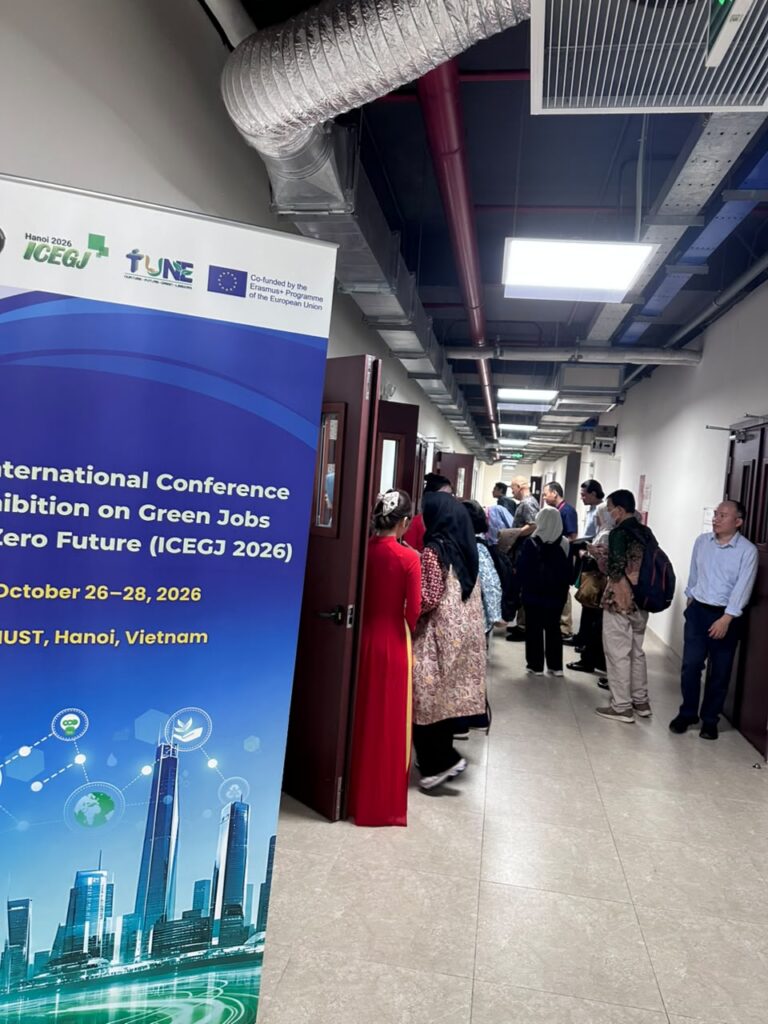
HANOI, VIETNAM — October 26, 2026 — Marking a major milestone in cross-continental higher education reform, the 1st International Conference and Exhibition on Green Jobs for a Net-Zero Future (ICEGJ 2026) opened today at the Hanoi University of Science and Technology (HUST). Convened under the banner “Aligning Green Skills – Advancing Policy – Transforming Workforces,” the flagship event serves as the premier dissemination milestone of the TUNE Project (Nurturing Future Green Leaders), an initiative co-funded by the European Union under the Erasmus+ Capacity Building in Higher Education (CBHE) programme.
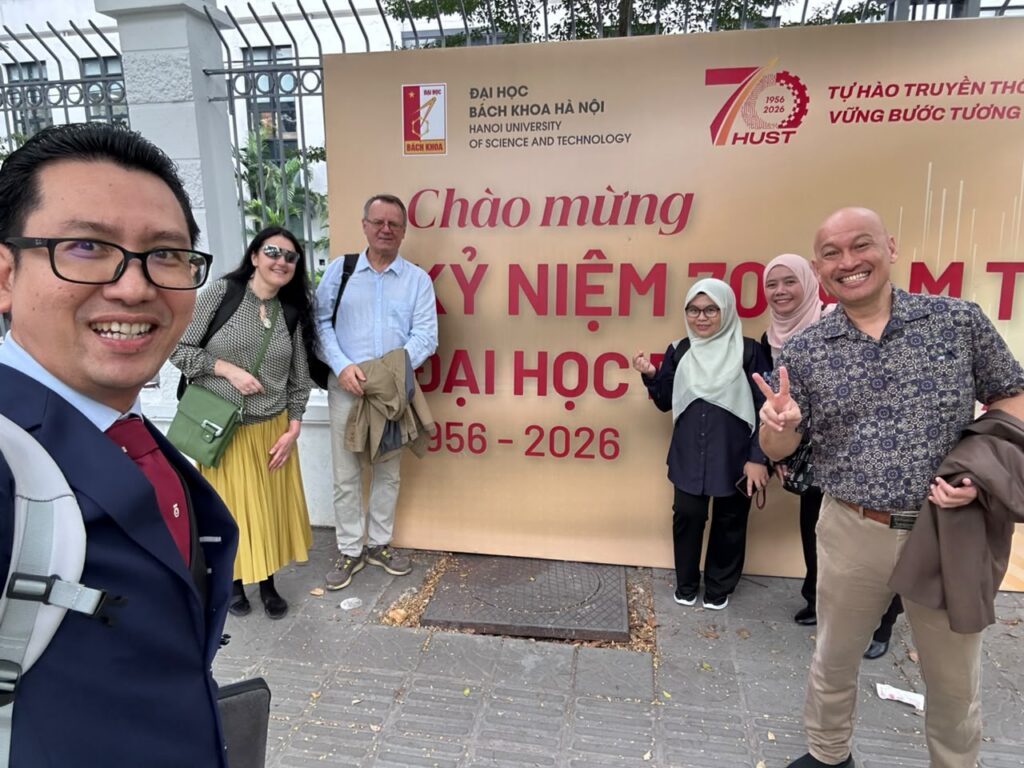
The opening of ICEGJ 2026 carries historic significance for the host institution, as it anchors the celebrations marking the 70th Anniversary of HUST (1956–2026). Over 200 delegates—including academic leaders, policymakers, industrial innovators, and students from across ASEAN and Europe—gathered at HUST’s C7 Building to bridge the critical gap between academic degrees and the rapidly emerging demands of the green economy.
Redefining Higher Education: A Unified Call from Consortium Leadership
Welcoming international delegates, Assoc. Prof. Dr. Huynh Dang Chinh, Vice President of HUST and Chairman of ICEGJ 2026, underlined that higher education institutions must urgently transition from conventional disciplinary boundaries toward integrated talent incubators. He commended the partnership with the European Union and ASEAN consortium universities, noting that HUST’s 70-year legacy of engineering and technological leadership is reinforced by championing net-zero workforce pathways.
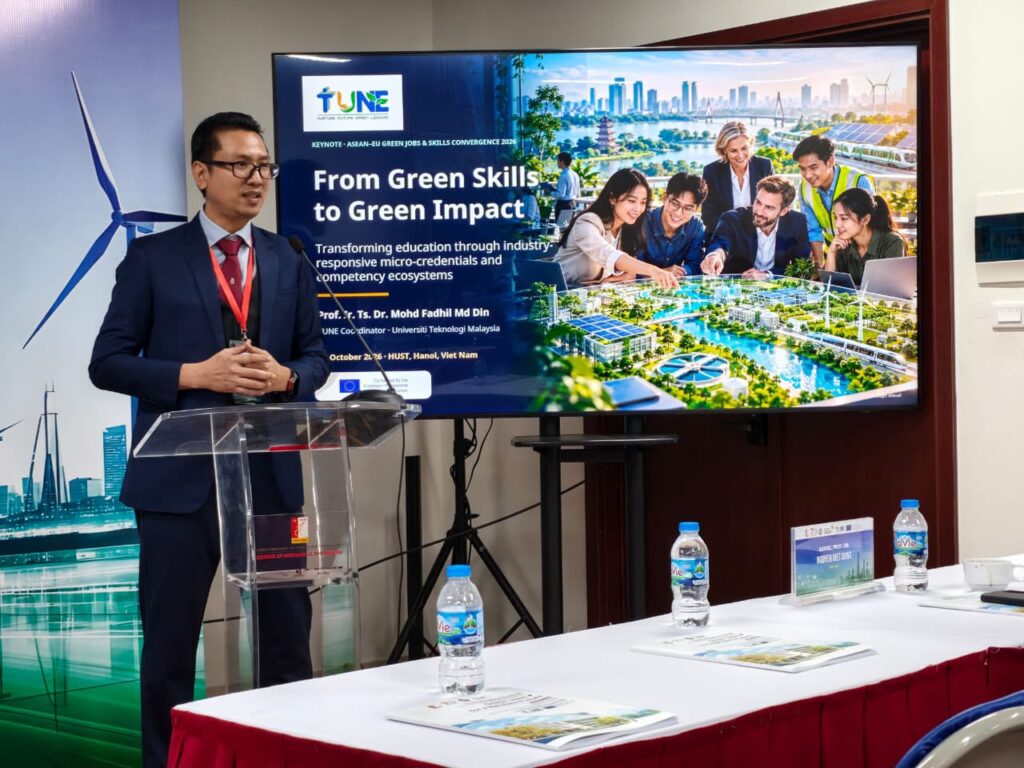
Delivering the official welcoming remarks, Prof. Ir. Ts. Dr. Mohd Fadhil bin Md Din, Project Coordinator of Erasmus+ CBHE TUNE from Universiti Teknologi Malaysia (UTM), articulated an ambitious roadmap for regional workforce evolution.
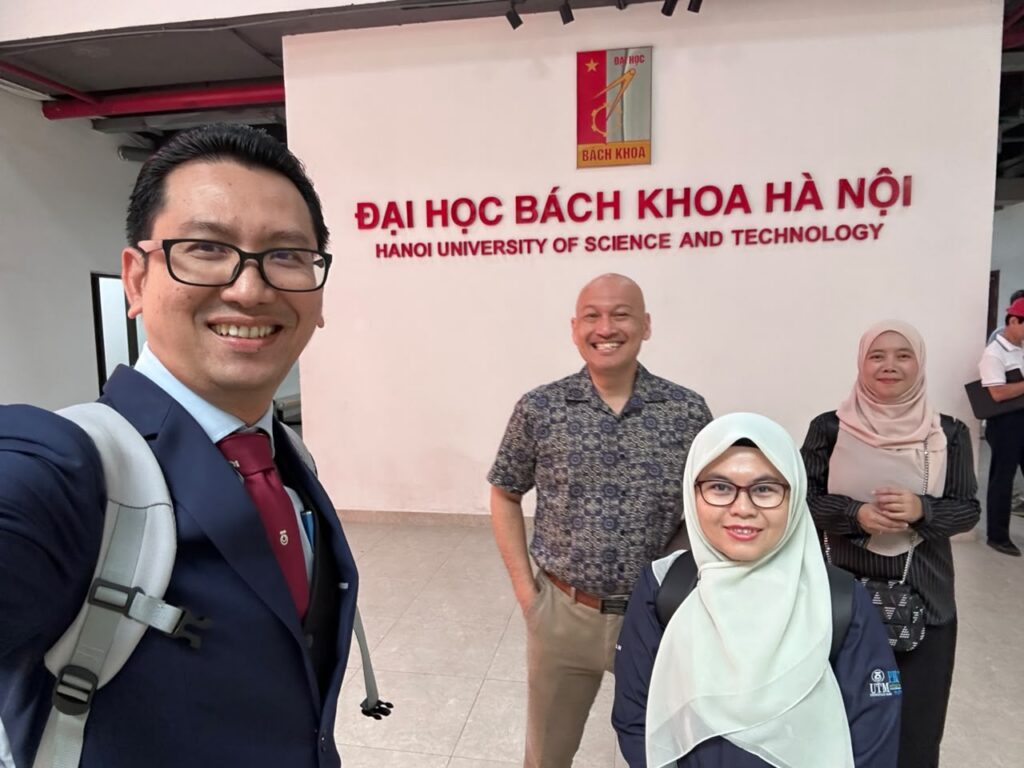
“The global green transition is fundamentally redefining employment. Green jobs are no longer isolated within renewable energy niches—they now govern manufacturing, engineering, agriculture, finance, and digital governance,” declared Prof. Fadhil. “Universities cannot remain mere degree mills; they must evolve into regional epicenters for lifelong reskilling, micro-credentialing, and sustainability leadership. Through the Erasmus+ CBHE framework, our collective mission is to transform sustainability ambitions into verifiable, workplace-ready capabilities.”
Issuing a direct call to action, Prof. Fadhil challenged every international delegation present to establish at least one tangible cross-border collaboration—whether a joint micro-credential, an industry living lab, or an applied research project—within the next three months.
Plenary Keynotes: Translating Green Ambitions into Systemic Capacity
The morning plenary sessions delivered rich technical and systemic insights into sustainable workforce preparation:
From Green Skills to Green Impact (Keynote 2): Delivered by Prof. Ir. Ts. Dr. Mohd Fadhil bin Md Din, this address unveiled the cornerstone pedagogical model of the TUNE project. Prof. Fadhil tackled the core bottleneck of the green transition: economies are legislating net-zero targets far faster than education systems can produce competent personnel. He championed the establishment of industry-responsive micro-credentials, dynamic Training-of-Trainers (ToT) frameworks, and a proposed “Green Competency Passport”—a verifiable digital portfolio demonstrating mastery in circular economy models, ESG reporting, and AI-enabled environmental problem-solving. Prof. Fadhil also embedded the Planetary Health imperative, asserting that human well-being and ecological integrity must be taught as inseparable systems.
Nature-Based Solutions and Urban Water Resilience (Keynote 1): Prof. Nicolaos P. Theodossiou (Aristotle University of Thessaloniki, Greece; President of AECEF) illustrated how transitioning from conventional “grey” civil infrastructure to Nature-Based Solutions (NBS) in urban flood mitigation creates multidisciplinary employment niches combining ecological monitoring, data-driven civil engineering, and community-centered environmental stewardship.
Vietnam’s National Energy Transition (Keynote 3): Assoc. Prof. Nguyen Duc Tuyen (HUST) detailed Vietnam’s human capital requirements to realize its 2050 Net-Zero emissions pledge. He stressed that technological adoption without regulatory alignment, smart-grid upskilling, and climate finance literacy will stall progress, urging engineering faculties to modernize degree structures.
Transforming Forestry into Green Livelihoods (Keynote 4): Ms. Chorirotun Nur Ulifah (Perhutani Forestry Institute, Indonesia) detailed state-enterprise implementation of the “Green Forests – Green Skills – Green Jobs – Green Business” pipeline, aligning carbon sink commitments (FOLU Net Sink 2030) with community-driven economic opportunities.
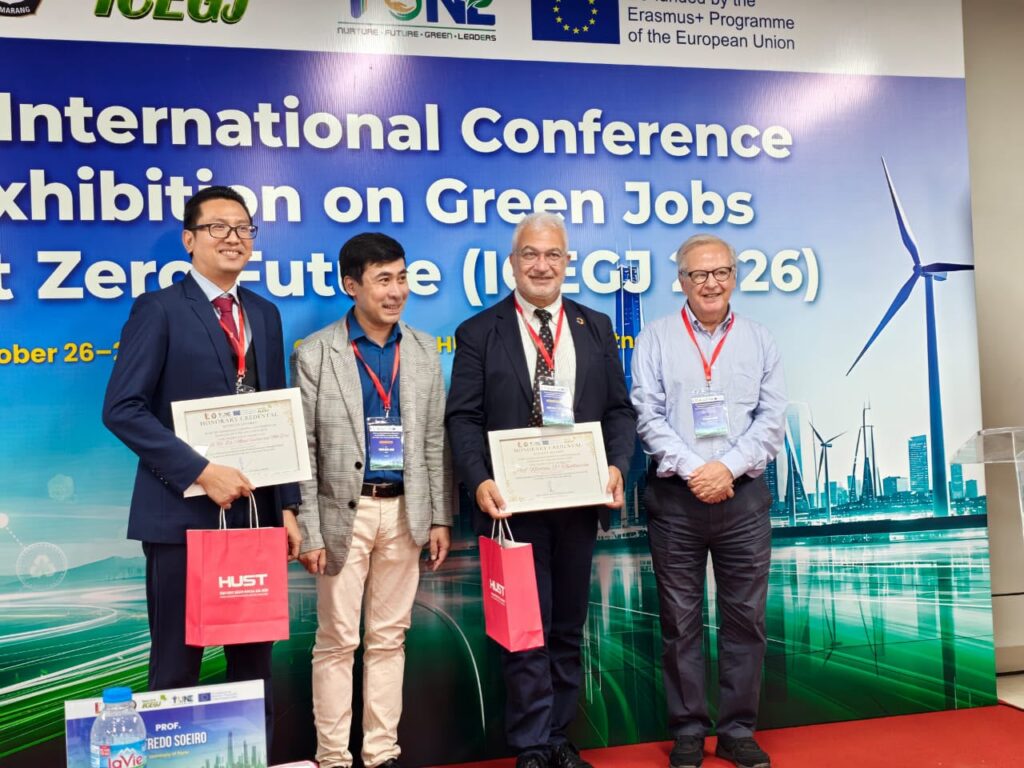
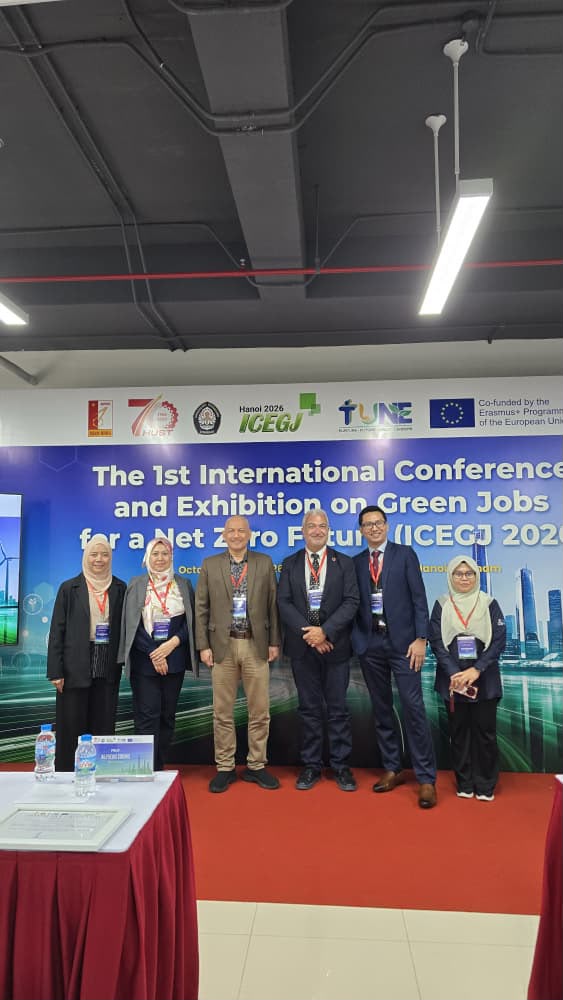
The morning culminated in an honorary credential presentation where consortium leaders recognized keynote contributors for advancing ASEAN–EU educational exchange.
Applied Research and Industrial Synergy
Day 1 progressed into four parallel technical tracks comprising dozens of peer-reviewed papers spanning AI-driven energy optimization, hazardous waste competency models, bio-based construction materials, and agro-forestry livelihoods. The day’s proceedings concluded with an official networking gala dinner at the Vietnam-Germany Center, setting a collaborative tone for Day 2’s industry-policy roundtables and the accompanying Green Jobs Exhibition